







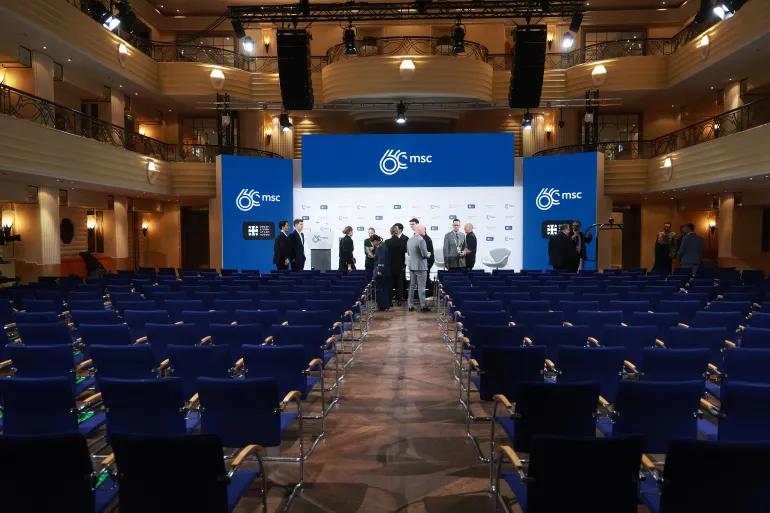
WORLD - The Munich Security Conference is a yearly gathering of world leaders to discuss global security challenges.
The 2026 edition included more than 1,000 leaders, diplomats, and security experts from over 115 countries, including around sixty heads of state and government.
This year, the focus was on the wars in Ukraine and Gaza, tensions within NATO, and uncertainty in U.S.-Europe relations.
The conference opened on Friday with warnings about the weakening of the rules-based international order. U.S. Secretary of State Marco Rubio said, “The old world is gone,” highlighting how rapid geopolitical changes are forcing countries to rethink their positions in what he described as a new era.
German Chancellor Friedrich Merz warned that the international system “no longer exists in its original form,” citing Russia’s war in Ukraine, growing competition among major powers, and tensions and conflicts in the Middle East.
Lebanese Participation
Lebanese Prime Minister Nawaf Salam attended the Munich Security Conference, where he met with President of the Presidential Leadership Council of Yemen, Dr. Rashad Al-Alimi, to discuss regional developments and ways to enhance Arab coordination.
Salam met with Ms. Melissa Park, Executive Director of the Global Campaign to Abolish Nuclear Weapons and 2017 Nobel Peace Prize laureate, praising the organization’s leading role in nuclear disarmament and promoting global peace.
Lebanon was also represented by Army Commander General Rudolph Heikal. A meeting of participating army leaders was held to review global developments and military cooperation issues.
On the sidelines, General Heikal held bilateral meetings with several officials and military leaders, including:
German Chief of Defense Gen. Carsten Breuer
British Chief of Defense Air Chief Marshal Sir Richard Knighton
Italian Chief of Defense Gen. Luciano Portolano
Dutch Chief of Defense Gen. Onno Eichelsheim
Pakistan Army Chief Field Marshal Syed Asim Munir
NATO Military Committee Chairman Admiral Giuseppe Cavo Dragone
NATO Secretary General Special Representative Javier Colomina
Senior Advisor to U.S. President Donald Trump for Africa and the Middle East Massad Boulos
Diplomatic Advisor to UAE President Anwar Al-Qirqash
Key Topics and Discussions
Participants discussed several topics, including:
• The future of multilateralism
• Economic and trade security
• Climate action
• Nuclear security
• The global technology race
• Artificial intelligence
Middle East Advisory Group
The conference published the main findings of the Middle East Consultation Group, based on months of research and field data from Gaza and the West Bank. These findings provided an in-depth understanding of political and social trends in a highly fragile region, giving policymakers tools based on real-time crisis data.
Food Security Task Force
The MSC Food Security Task Force concluded a two-year program that brought together stakeholders from national security, development, governments, international organizations, and the private sector.
The focus was on securing global food supply chains and protecting them from political and climate crises, highlighting the link between food security, political stability, and economic resilience.
Tech Strategy Initiative
The conference launched the Tech Strategy Initiative to explore transformative technological developments that are still outside the focus of many policymakers, analyzing both risks and geopolitical opportunities.
The first cycle focused on advanced artificial intelligence, reflecting its growing role in reshaping global power dynamics.
Interactive Hubs
Three parallel discussion spaces, or “Hubs,” were established to broaden public dialogue and engage new participants in linking security issues to economic, technological, and social changes.
Startup Hub: Connects security decision-makers with innovators and entrepreneurs, turning innovation into a tool for resilience and partnership.
Energy Security Hub: Brings leaders and experts together to explore affordable, clean, and secure energy supplies, highlighting the link between energy security and social-economic stability.
Emerging Leaders Hub: Offers intergenerational dialogue on European security, transatlantic cooperation, and cyber threats, giving young leaders a direct voice with decision-makers.
The Munich Security Conference 2026 highlighted the evolving nature of international security, where political, economic, technological, and environmental issues intersect in a world of increasing instability and complex decision-making.


