




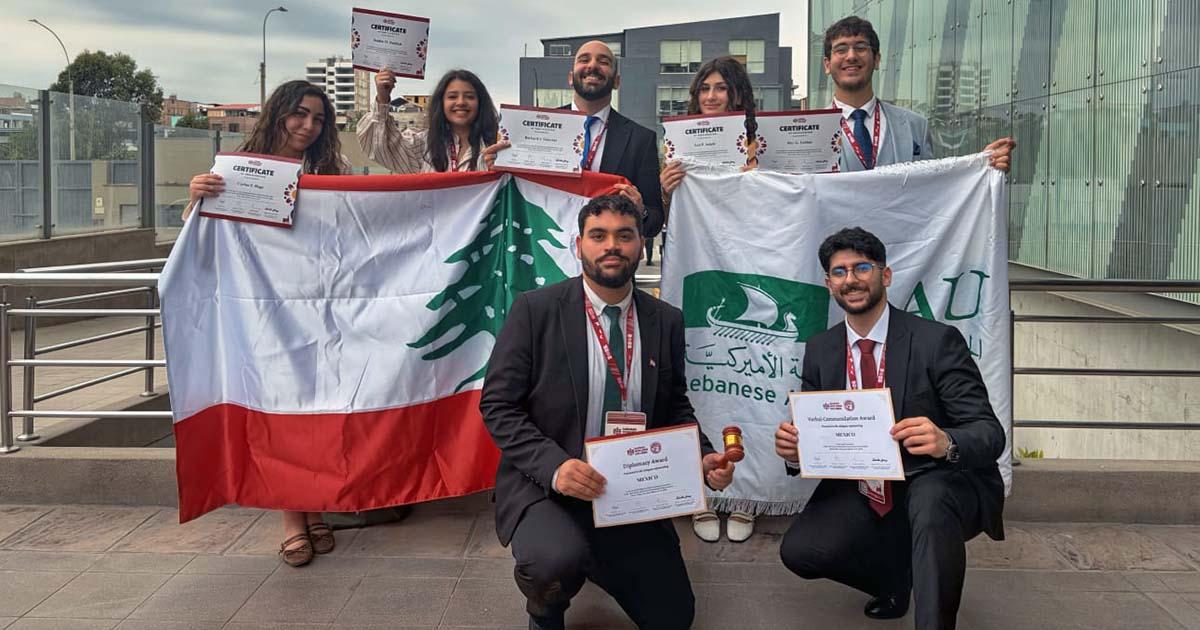
LEBANON – In a notable achievement on the international stage, Lebanese American University student Roy Abi Raad won the Diplomacy Award during his participation in the Harvard World Model United Nations, one of the world’s leading platforms simulating the United Nations.
In an exclusive interview with Enmaeya, Abi Raad recounts his journey spanning years within the world of Model United Nations, diplomatic engagement, and student-led development activities, culminating in this achievement, and the academic, logistical, and security challenges he faced amid the complicated conditions in Lebanon.
From Classroom Beginnings to a Passion for Diplomacy
Abi Raad recalls his early journey, saying: “My journey with Model UN began around three years ago, when I participated in a conference organized by the Lebanese American University for school students."
"I won the Secretary-General award, which marked a turning point that strengthened my interest in UN-related debates and political affairs, and encouraged me to pursue studies in Political Science and International Affairs," he added.
Selection and Intensive Training Before Harvard World MUN
Regarding his selection, he recalls that the process began about five months ago, when the Lebanese American University held an internal competition to choose students to represent the university at the conference.
“We went through a competitive evaluation process, where a limited number of participants were selected based on performance and skills in research, negotiation, and communication,” he explains.
Following the selection stage, participants entered an intensive four-month training program with weekly structured sessions. “During this period, we worked extensively on academic research skills, understanding country profiles and policy issues, as well as negotiation techniques and resolution drafting,” he adds.
The training, he notes, provided both academic grounding and practical preparation, ensuring participants arrived at the conference with a strong sense of readiness.
A Highly Competitive Global Simulation
Describing the conference, Abi Raad explains that it functions as a highly competitive academic simulation of the United Nations, bringing together students from around the world to represent their universities and assigned countries. “It involves negotiation, policy debates, and drafting resolutions that reflect national positions,” he says.
He adds that he participated in the Special Political and Decolonization Committee (SPECPOL), which focuses on political issues and questions of decolonization, particularly discussions surrounding Non-Self-Governing Territories. “We represented Mexico, which required a deep understanding of its diplomatic stance and how to translate it into negotiations,” he notes.
Challenges Beginning with Visa Procedures
Participation was far from easy, as the delegation faced several challenges from the outset.
“The challenges began with obtaining the travel visa, as there is no Peruvian embassy in Lebanon. We had to send our passports abroad, and they only arrived a day before departure, leaving us uncertain until the very last moment," Abi Raad explains.
He adds: “We were also the only delegation from the Middle East, after other teams were unable to attend. Even after securing visas, a major security challenge emerged due to repeated strikes near Beirut Airport, making the journey highly risky, especially as we crossed three airports without any guarantee of return.”
Mexico and Lebanon: A Shared Diplomatic Perspective
Reflecting on representing Mexico, he says: “Foreign policies differ from one country to another, but Mexico’s position on decolonization was diplomatic and neutral, which I found closely aligned with Lebanon’s reality. I felt I was representing both Mexico and Lebanon at the same time, especially under the circumstances we are going through.”
He continues: “We worked on drafting a resolution with delegations from countries such as Morocco, France, and the United States. It was a rich experience in which I learned the importance of building trust networks before any negotiation, as diplomacy is about finding common ground between different interests to reach consensus.”
A Message to the Youth
In conclusion, Abi Raad emphasized the importance of youth participation in politics in "strengthens confidence in the future and brings new energy and perspectives into politics."
"We are a generation that has lived through the consequences of past decisions, which makes us more aware of the challenges and more determined to create change," he says.
He adds: “We do not view politics as a traditional framework only, but as a space to reshape solutions more practically and innovatively, away from sectarian divisions. Young people are capable of offering new, inclusive approaches that prioritize the interests of society".
Roy Abi Raad’s experience goes beyond winning an international competition; it reflects the journey of Lebanese youth engaging in global spaces despite local challenges.
In a context of ongoing crises, this achievement highlights the capacity of the new generation to redefine its role in politics and diplomacy through knowledge, dialogue, and trust-building.