






![The UAE announced its departure from OPEC on April 28, 2026, effective May 1. [File: Ramzi Boudina/Reuters]](/_next/image?url=https%3A%2F%2Fenmaeya-production.s3.eu-west-1.amazonaws.com%2Fglobal%2Fimage%2FIfIDuGHfHZuFB9FPttkZZgYm_1777457219464_ZcgKf.webp&w=3840&q=75 "The UAE announced its departure from OPEC on April 28, 2026, effective May 1. [File: Ramzi Boudina/Reuters]")
The United Arab Emirates has announced its departure from OPEC+, one of the most powerful energy alliances in the world. But to understand why this matters, you first need to know what OPEC actually is.
A Group Built on Oil
OPEC, the Organization of the Petroleum Exporting Countries, was founded in 1960 by five countries: Iraq, Iran, Kuwait, Saudi Arabia, and Venezuela.
In August 1960, Exxon announced a reduction of 10 to 14 cents per barrel in the price it paid for Middle Eastern crude, leaving Saudi Arabian light oil at $1.80 per barrel, the same price it had been in 1949. The other major Western oil companies followed. For the governments that owned that oil, this translated to a direct drop in national income. OPEC was their response.
Today, the group has expanded into OPEC+, which brought in Russia, Azerbaijan, Bahrain, Kazakhstan, Malaysia, Mexico, Oman, South Sudan, and Sudan. Together, they control roughly 40% of global oil supply.
How It Works
OPEC+ functions by setting production quotas: agreed limits on how much oil each member country can produce. When the group decreases production, global oil prices rise, as oil demand surpasses its supply. When it increases oil production, prices fall. That is the core of their power.
Saudi Arabia leads the group and carries the most weight in these decisions. It is the world's largest oil exporter, producing around 9 to 10 million barrels per day. That is nearly a quarter of everything OPEC produces, which is why its decisions carry so much weight.
For oil-importing countries, including several Arab countries like Lebanon, Egypt, Jordan, OPEC+ decisions translate directly into import costs. When the group cuts production and prices rise, governments spend more on energy imports, often in foreign currency. This puts pressure on trade balances and public budgets. Countries with limited reserves or high existing debt may need to borrow to cover the gap, adding to fiscal pressure.
Over time, long-term high energy costs can push governments toward spending reductions, particularly in public investment and social services, contributing to slower growth and, in more fragile economies, recurring financial instability.
Lebanon is a clear example. The country imports nearly all of its energy needs and carries a public debt equivalent to around 164% of GDP, according to 2024 figure, making it one of the most indebted countries in the world relative to the size of its economy. Energy price shifts driven by OPEC+ policy directly impact an economy as it has limited capacity to absorb these shocks.
Some Numbers Worth Knowing
OPEC+ currently has 22 member countries. The group has been producing around 40 million barrels of oil per day. The UAE alone produces approximately 3 to 4 million barrels per day, placing it third within OPEC, ahead of Kuwait and Iran. That is a substantial share for a country that represents a fraction of the group's membership.
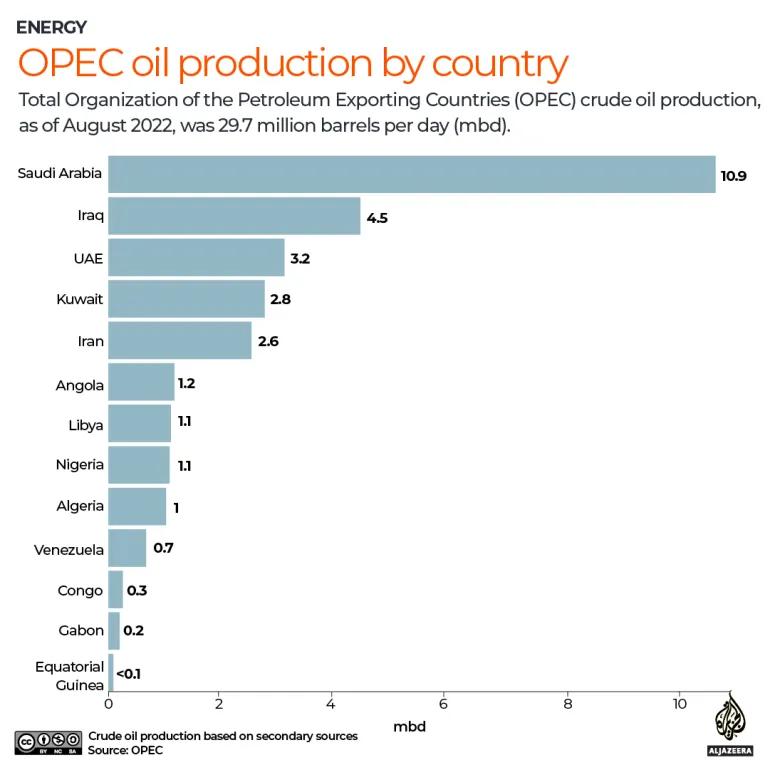
OPEC oil production by country, Al Jazeera / Source: OPEC, August 2022
Non-OPEC+ producers, led by the United States, account for the remaining 60% of global output. The US alone now produces more oil than any single OPEC member, which is part of why the group's internal unity matters more than ever.
The Economic Implications
Here are two options:
As instability across the Middle East deepened, differences over how to manage oil policy and broader priorities became harder to ignore within OPEC+.
The economic consequences of the UAE's departure are significant. The country holds the second largest spare production capacity in OPEC+ after Saudi Arabia, a key tool for influencing global prices and responding to supply disruptions. Its exit, analysts say, leaves the group structurally weaker. Free from production quotas, the UAE can now increase its output independently, joining producers like the United States and Brazil that operate outside any coordinated framework. For a group that has shaped global energy markets for six decades, this marks a meaningful shift.