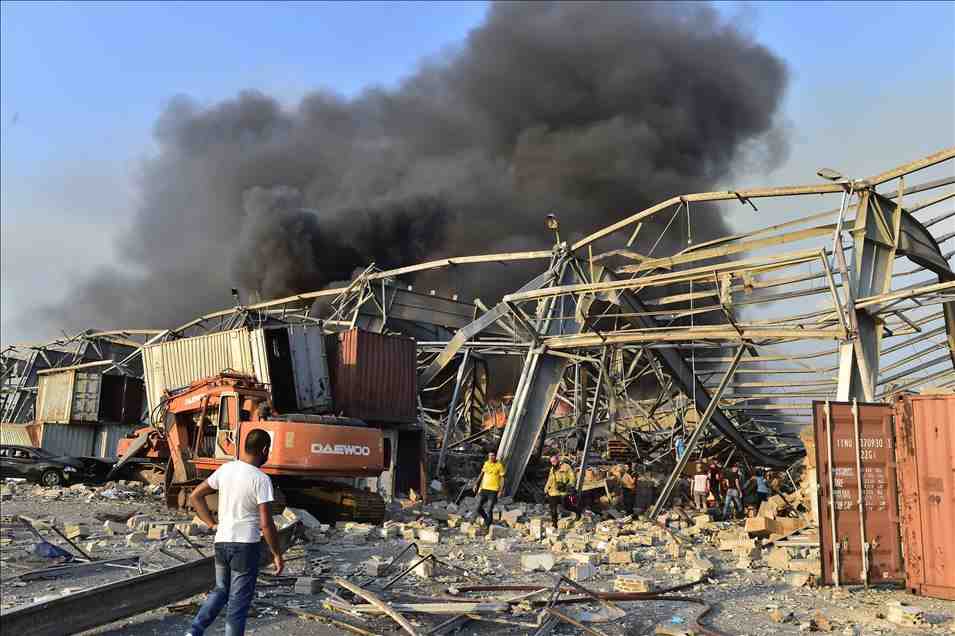







![The rubble of shops destroyed in Israeli air strikes in the Hosh neighbourhood of Tyre, southern Lebanon [File: Bilal Hussein/AP Photo]](/_next/image?url=https%3A%2F%2Fenmaeya-production.s3.eu-west-1.amazonaws.com%2Fglobal%2Fimage%2FNBO9nmK9fHloQpk3AYPn4SPqt_1779099154813_zArbu.webp&w=3840&q=75 "The rubble of shops destroyed in Israeli air strikes in the Hosh neighbourhood of Tyre, southern Lebanon [File: Bilal Hussein/AP Photo]")
LEBANON – The National Council for Scientific Research (CNRS), in collaboration with the National Center for Geophysics (NCNE), released a comprehensive statistical report monitoring the scale of attacks and the destruction of housing units across different Lebanese governorates, highlighting unprecedented levels of material damage and aerial and ground attacks.
According to the report, 8,200 attacks were recorded between March 2, 2026, and April 16, 2026, including 5,321 shelling incidents and airstrikes, 1,527 artillery shells, 92 phosphorus shells, and 1,260 attacks of other types.
The report pointed to a significant escalation in recent weeks, with 3,318 additional violations and attacks documented in just 24 days (from April 17 to May 11, 2026), alongside 2,324 recorded airspace violations.
During a 22-day period (from April 17 to May 8, 2026), these violations caused extensive destruction and damage to housing units, including 5,386 completely destroyed units and 5,246 partially damaged units.
The report stated that the total number of damaged, fully destroyed, and partially damaged housing units since the beginning of the war (2023/2024) until May 8, 2026, reached 230,436 housing units.
It also explained that the period from March 2 to May 8, 2026 alone witnessed the destruction and damage of 61,056 housing units, distributed across governorates as follows: Nabatieh ranked first with 33,930 damaged units, followed by South Lebanon with 15,723 units, then Mount Lebanon and Beirut with 8,838 units, Baalbek-Hermel with 1,305 units, and the Bekaa with 1,260 units.
According to the report, these damages account for nearly 26% of the total damages recorded during all previous periods combined, reflecting the scale of the escalation and the unprecedented intensity of operations.
Among the most affected villages during the same period, the town of Khiam topped the list with 651 destroyed and damaged housing units, followed by Bint Jbeil, Zawtar Al-Sharqiyah, Kafra, Yaroun, Taybeh, Srifa, and Mansouri.
The report concluded by stressing that these figures reflect the magnitude of the urban and humanitarian catastrophe facing the country amid continued escalation and its direct impact on civilians and residential infrastructure.