






SAIDA - Lebanon’s Constitution marked its centenary on 23 May 2026. This milestone invites deeper reflection on a founding text that has shaped the country’s political life, institutional framework, and public debates for an entire century. Yet the significance of the moment lies not only in commemoration, but in how it is being used to reopen a broader national conversation about citizenship, the state, and constitutional life in Lebanon today.
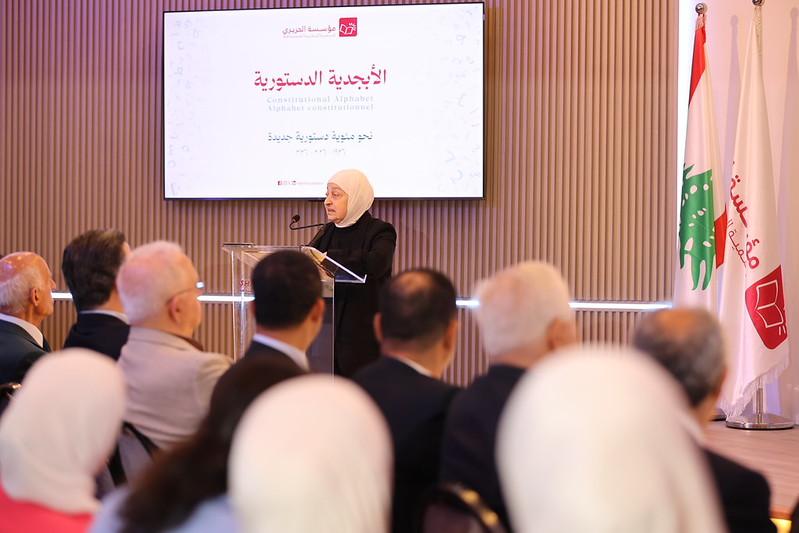
It is in this context that the Hariri Foundation for Sustainable Human Development launched the “Constitutional Alphabet” program during a ceremony held at the “National State Academy” in Sidon, bringing together representatives from official, municipal, legal, academic, health, educational, economic, social, and youth sectors.
A digital Platform at the Center of the Initiative
At the heart of the initiative is the “Constitutional Alphabet” digital platform, designed as a constitutional lexicon that makes the Lebanese Constitution accessible across languages, generations, and disciplines.
The platform allows users to read the Constitution in Arabic, French, and English, while also engaging with a structured glossary of constitutional and civic terminology. It goes beyond access to text by introducing visual and analytical tools that map constitutional articles, trace key concepts, and organise legal language into interconnected systems of meaning.
By shifting constitutional reading into an interactive experience, the platform reframes civic knowledge as something participatory rather than passive, turning the Constitution into a framework that can be explored, questioned, and applied to contemporary life.
“Not a Passing Occasion”
Speaking at the launch, President of the Hariri Foundation Mrs.Bahia Hariri stressed that the initiative is “not a passing occasion, but a national effort aimed at rebuilding the relationship between citizens and the state, between freedom and responsibility, between diversity and unity, and between the citizen and the Constitution, on the basis that stability is a shared responsibility, and that the state is not merely a system of governance, but a contract of trust, partnership, and shared destiny.”
She placed the program within a broader historical reflection, noting that over the past century, Lebanese citizens have not had sufficient opportunity to transform social contracts into a lived constitutional culture: one that is embedded in daily awareness and passed across generations. This, she suggested, has limited the development of a stable civic consciousness grounded in shared constitutional understanding.
Mrs.Hariri further emphasised that the state is not simply a structure of authority, but the outcome of a long human experience in the search for stability and coexistence. It represents, in her words, the highest expression of collective will, where values are translated into systems that protect dignity, regulate difference, and prevent fragmentation.
She also underlined that constitutions are not static legal texts, but living frameworks of collective awareness. They function simultaneously as moral and legal references that define rights and responsibilities while preserving diversity within a unified national framework. In this sense, she described the initiative as an attempt to build a shared civic language.
A 100-day Civic Program
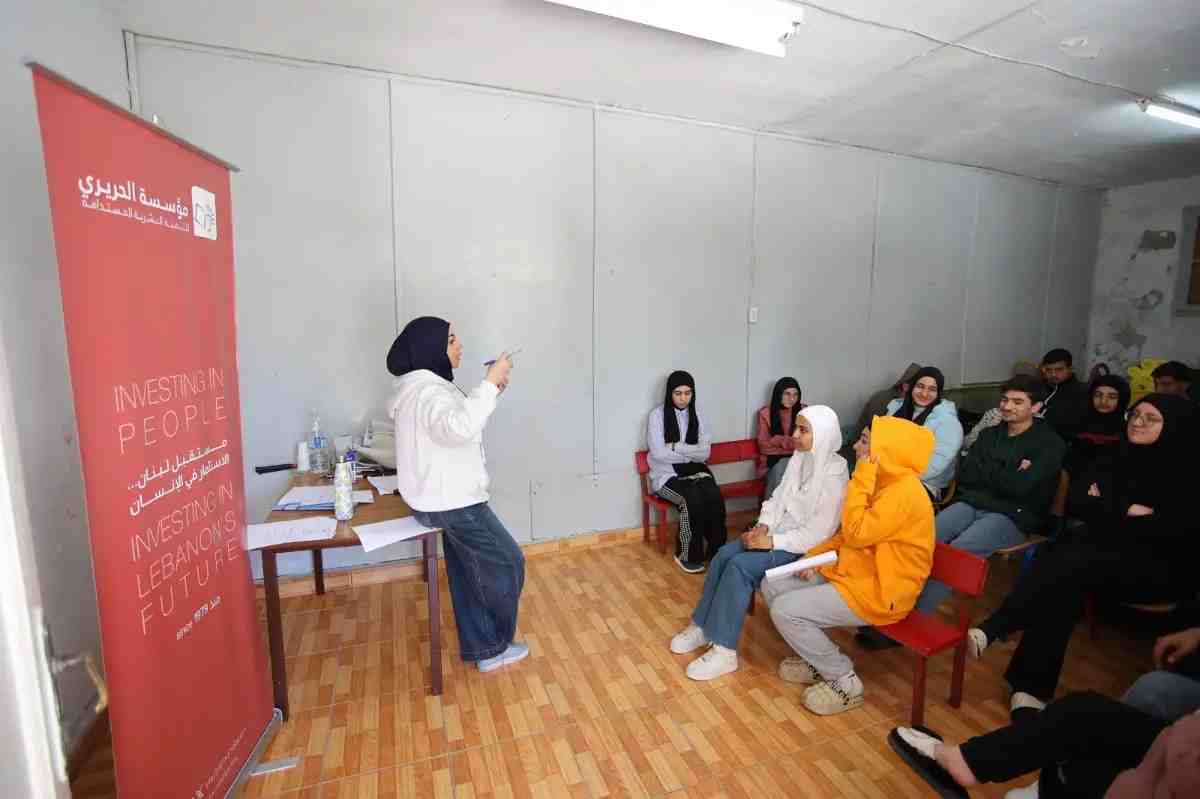
The program was formally launched during the event at the “National State Academy” in Sidon as a 100-day initiative running from 23 May to 1 September 2026. It brings together work led through the National State Academy, the Youth of Rise of Lebanon Forum, and the Civic Education Program, combining academic expertise with the use of artificial intelligence tools to strengthen interactive civic learning.
Following the opening session, the Hariri Foundation team at the National State Academy presented an overview of the “Alphabet” methodology, focusing on how constitutional terminology is identified, tracked, and analysed. The approach examines how terms appear within the constitutional text, how they are formulated, and how their usage evolves across contexts.
Rather than treating constitutional language as fixed, the methodology frames it as a dynamic system that can be studied, organised, and interpreted in ways that deepen civic understanding.
Members of the Youth of Rise of Lebanon Forum then presented data-driven insights into the program’s main pillars: “the state, system of governance, identity, rule of law, rights and freedoms, development, and security and defence,” along with their sub-themes, sample terms, and related indicators.
Their presentation translated constitutional concepts into structured categories that can be analysed and discussed more concretely, bridging abstract legal principles with measurable civic frameworks.
Rebuilding the Civic Relationship
Taken together, the initiative positions constitutional education as a shared public practice rather than a specialist domain. It reflects an effort to reconnect citizens with the foundational ideas of the state through language, interpretation, and participation.
At its core, the Constitutional Alphabet is presented as an attempt to rebuild the relationship between citizens and the state—between freedom and responsibility, diversity and unity, and between constitutional text and lived reality—through a shared civic vocabulary for understanding Lebanon today.