








MIDDLE EAST - July 11th is World Population Day, a day that highlights issues related to family planning, maternal health, gender equality, and sustainable development. In the early 1970s, women had on average 4.5 children each; by 2015, total fertility for the world had fallen to below 2.5 children per woman. Meanwhile, average global lifespans have risen, from 64.6 years in the early 1990s to 72.6 years in 2019.
What is the total fertility rate?
The Total Fertility Rate (TFR) is the average number of children a woman would have in her lifetime, assuming she lives through her childbearing years and experiences the current, age-specific birth rates.
A TFR of approximately 2.1 is widely known as the "replacement level." This means a population is replacing itself from one generation to the next without migration. In other words, a TFR higher than 2.1 indicates a growing population, while a TFR below 2.1 indicates an aging population.
What are the numbers in the Arab region?
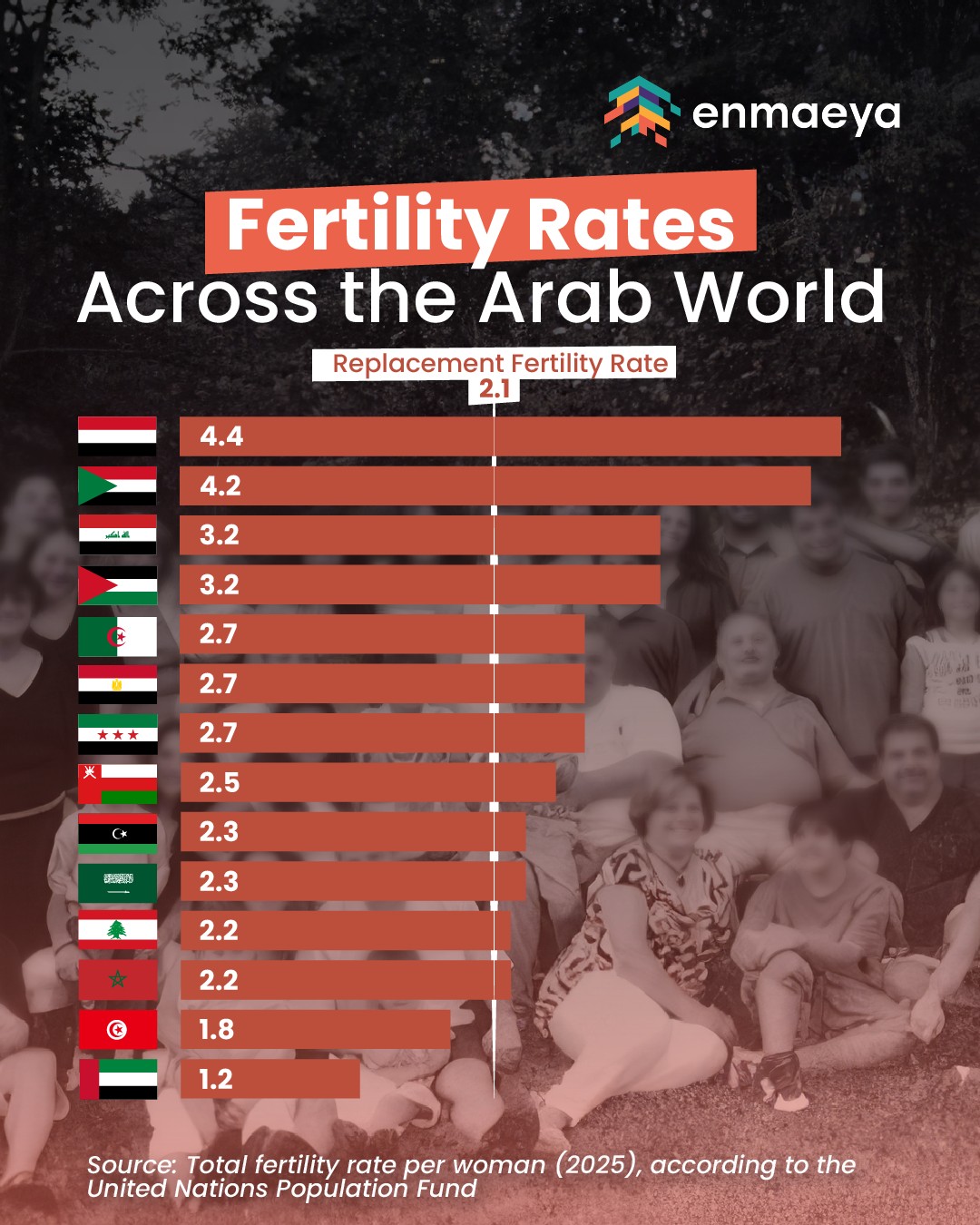
A closer look at the TFR
A clear pattern emerges on closer inspection: the countries with the highest fertility rates, Yemen, Sudan, Palestine, and Iraq, all sit above 3, and all four have experienced significant turmoil over the last decade, including sustained armed conflict.
What drives the high TFR in these countries?
Armed conflict tends to sustain high fertility through several interlocking channels: greater social insecurity, disrupted reproductive health services, and lower female education.
The loss of reproductive health services is closely tied to reduced access to contraception and family planning care. Building the healthcare infrastructure needed to meet demand for family planning is rarely a priority during active conflict, and even where services exist, they're sometimes met with resistance when they don't reflect local cultural or religious sensibilities.
Lower female education is another driving force. Research consistently links girls' schooling to the age at which they marry and the number of children they go on to have: fertility rates decline as women's education rises relative to men's, and studies estimate that raising women's schooling from half of men's level to parity is associated with fertility falling from roughly six children per woman to two.
Conflict interrupts this pathway directly. Research modeling the demographic effects of armed conflict has found that girls exposed to conflict before age 11 go on to marry earlier, begin childbearing sooner, and have higher completed fertility than their peers, even after accounting for education, wealth, and location.
There's also a longstanding idea in demography, sometimes called the "old-age security" or "insurance" hypothesis, that in unstable or resource-poor settings, having more children functions as a hedge: more hands to support the household, and more chances that some children survive into adulthood to care for aging parents.
In active conflict zones, this logic can sharpen. Armed conflict exposes enormous numbers of women and children to danger and displacement; more than 630 million people were affected in 2017 alone, and in that climate of loss and uncertainty, larger families can feel like both an emotional anchor and a practical safety net.
Countries with decreasing TFR
Despite the countries above, recent years show an overall decline in fertility across the Arab region. Egypt and Saudi Arabia have both moved well off their fertility peaks of the 2000s and 2010s, when rates in both countries sat above 3.
Tunisia and the UAE have gone further still, dropping below the replacement rate. Tunisia now sits at 1.8, and the UAE at 1.2, among the lowest in the region.
What's driving the falling TFR?
UNFPA's newly released Demographic Futures Survey 2026, based on responses from more than 108,000 young adults aged 18–39 across 73 countries, found that the global decline in fertility isn't a sign that young people don't want children; it's that many feel unable to have the family they want.
Financial security topped the list of what people said they need before forming a partnership, cited by 81% of respondents. While 88% said financial security was a precondition for having children, followed closely by stable employment and emotional readiness.
In the MENA region specifically, this economic squeeze shows up as rising child-rearing costs, inflation, growing female employment, and a housing market that makes starting a family harder to plan for.
Alongside the economics, cultural shifts are playing a role too: more women pursuing careers and delaying marriage, a generational cooling on early family formation, and a gradual loosening of the traditional norms that once made large families the default expectation.
On the other side of the ledger, several public-health gains have quietly pushed fertility down as well, improved primary healthcare and family planning integration, greater parental confidence that children will survive to adulthood, falling infant and maternal mortality, wider access to modern contraception, stronger maternal-child health services, more hospital capacity relative to population size, and growing male involvement in family planning decisions.
Together, these changes mean families feel less need to have "extra" children as insurance against loss, which, paired with the economic pressures above, is steadily reshaping family size across the region.
So, what does it all mean?
Put it all together, and the Arab world's fertility map basically tells two overlapping stories at once: countries scarred by conflict where big families are still a kind of security blanket, and countries riding a wave of education, healthcare, and urban life where two kids (or fewer) is starting to feel like plenty.


