




LEBANON - A new study proposes an unconventional early-warning tool for economic downturns: regularly asking young people how they view their country’s economic and social future.
The study, “A Youth Sentiment Index as a Leading Economic Indicator,” by Jihad El Hokayem of Rethinking Lebanon, the American University of Beirut and Saint Joseph University of Beirut, was published in the Journal of Economic and Social Measurement, a peer-reviewed academic journal published by SAGE.
The paper argues that youth sentiment can provide an early indication of economic direction because young people are often among the first to experience changes in the labor market. They tend to enter and leave jobs more frequently than older workers, making their perceptions potentially sensitive to shifts in economic conditions.
How the Youth Indicator Would Work
The proposed index would survey a representative sample of young people aged 15 to 24, including both those living in Lebanon and Lebanese youth abroad.
Participants would answer questions covering their living conditions, employment prospects, economic expectations, government performance, safety and trust in institutions. A key focus would be whether they believe the country will be better or worse off in the years ahead.
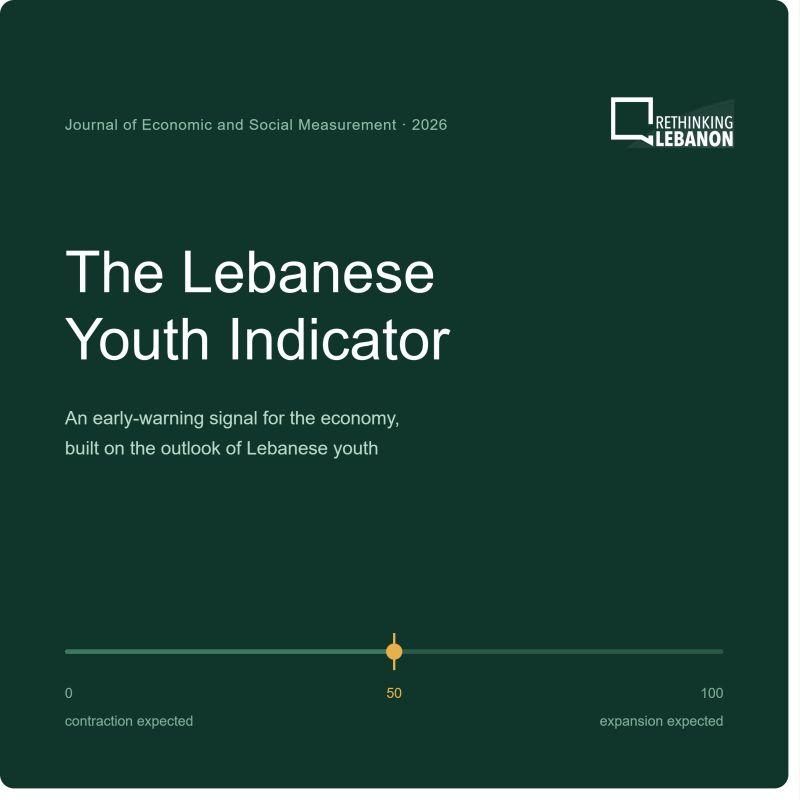
Each question would offer three possible responses: better, worse or no change. The answers would then be combined into a single score ranging from 0 to 100 using a diffusion formula similar to the one behind the widely used Purchasing Managers’ Index (PMI).
A score of 50 would serve as the key threshold. A reading above 50 would indicate more positive youth sentiment and suggest improving economic conditions, while a reading below 50 would point toward greater concern and the possibility of future economic contraction.
The study proposes that a score below 45 for two consecutive periods should prompt the government to formally review its economic and social policies.
Why It Could Matter for Lebanon
The proposed indicator comes at a time when Lebanon faces significant gaps in timely economic information. Since the country’s financial and economic crisis began in 2019, reliable data has become harder to obtain, while many existing indicators arrive too late to provide an early warning.
A youth survey could offer a relatively fast and low-cost alternative. The study suggests that Rethinking Lebanon could implement it in partnership with a university or public institution without requiring substantial financial resources.
Including Lebanese youth living abroad would also give the indicator a distinctive dimension. Emigration has become a major part of Lebanon’s economic reality, and the survey would distinguish between respondents living inside and outside the country.
Their expectations about Lebanon’s future could provide insight into confidence in the country’s economic prospects and willingness to remain connected to it.
A New Approach to Economic Forecasting
Youth surveys and consumer confidence measures already exist in many countries, but the study argues that there is no established national economic warning index built specifically around young people’s views.
The proposed Lebanese Youth Indicator is therefore presented as a first-of-its-kind PMI-style leading indicator focused exclusively on youth sentiment.
The study remains conceptual: the index has been theoretically developed and operationalized but has not yet been tested through an actual survey. Its author is inviting Lebanese institutions, universities and international partners to collaborate with Rethinking Lebanon on a first round.
If implemented, the indicator could serve two purposes at once: providing policymakers with an additional signal of where the economy may be heading, while giving young people a more direct role in shaping economic and social policy.