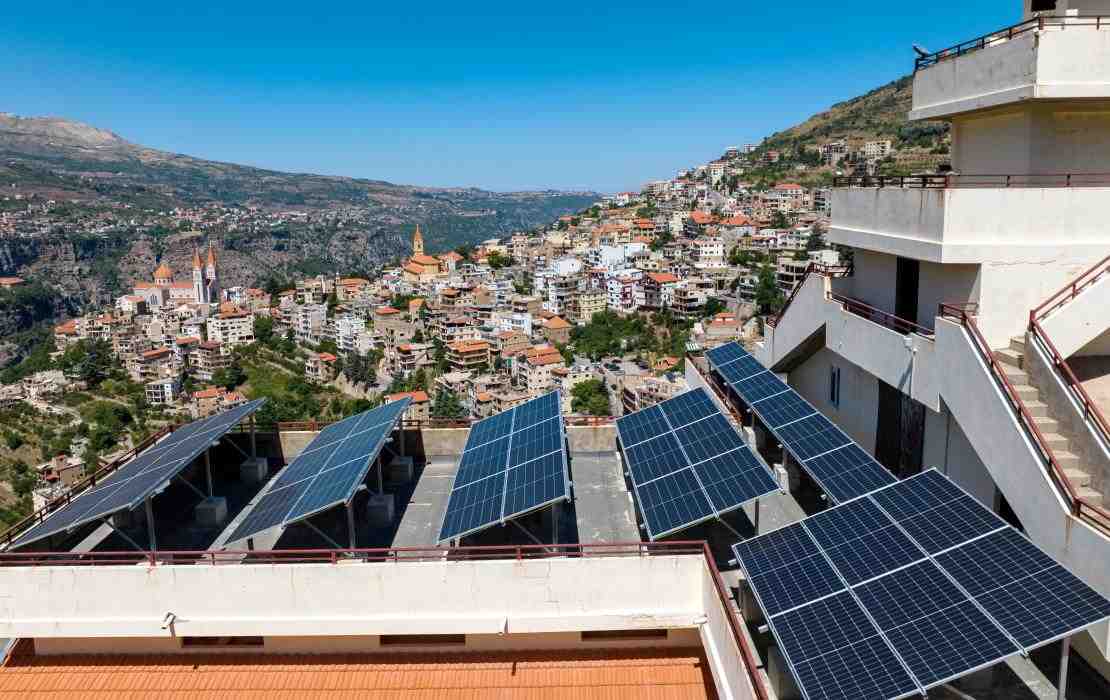








LEBANON - As generator bills climb again, Lebanon faces a new energy question: must every household buy its own way out of the electricity crisis, or can the country's solar boom become something more collective?
For years, Lebanon's electricity crisis has forced households to assemble their own energy mix: a few hours from Électricité du Liban (EDL), the neighbourhood generator when the grid goes dark, and, for those who can afford it, solar panels and batteries on the roof.
In August, the fragility of that model was felt again. The official tariff for private generators rose to LL48,241 per kilowatt-hour in urban and densely populated areas, about $0.54, up 19% from July and almost 60% from February.
The increase coincided with a sharp decline in EDL production due to delayed fuel supplies, increasing households' dependence on generators just as electricity became more expensive.
Solar Offered an Exit, But Not For Everyone
The recently published study “Towards Collaborative Energy in Lebanon: Global Models for Local Visions for the Electricity Sector,” prepared by the Ebla Research Collective and published by the Arab Center for Research and Policy Studies – Beirut, notes that installed photovoltaic capacity increased sevenfold following the crisis.
Solar's share of electricity generation rose from 2% in 2021 to 15% in 2023, while renewables accounted for around 20% overall. Households, businesses, and the Lebanese diaspora financed much of that expansion privately rather than through a coordinated national electricity transition.
Solar therefore became a form of energy self-protection. A household capable of paying several thousand dollars for panels, an inverter, and batteries could dramatically reduce its reliance on diesel generators.
But this raises another question: what about households that cannot?
Renters may not control their roofs. Dense apartment blocks have limited surface area. Co-owners may disagree over investment. Lower-income households may simply lack the upfront capital.
The Ebla study warns that this fragmented transition can reproduce inequality: better-off households can secure electricity through their own resources, while poorer households remain dependent on generators, or inadequate electricity altogether. It places this divide within an electricity landscape that still includes roughly 11,000 private-generator operators.
What If Electricity, Rather Than Panels, Was Shared?
Instead of assuming that every apartment needs its own panels and battery, collaborative energy allows residents to jointly produce, finance, manage or use electricity. The idea can range from a shared building system to neighbourhood or municipal projects.
Lebanon already has small examples. In al-Mina, Tripoli, the Ebla study documents residents negotiating access to rooftops and other available spaces and forming small groups that shared inverters and batteries.
Some established common maintenance funds, while arrangements involving around 90 households emerged. In Beirut, a building on Hamra Street with 21 apartments and eight shops developed a more structured model: residents shared infrastructure costs, collectively evaluated suppliers and used voting and dispute-resolution procedures to manage the system.
These experiments are small and imperfect. But they suggest a different question from the familiar “Should I install solar?” Could a building, neighbourhood or community produce electricity together?
Can Regulation Enable Shared Energy?
Technically, Lebanon is moving closer to such possibilities. Law 318/2023 on Distributed Renewable Energy provides a legal basis for several forms of net metering, including collective arrangements, and for peer-to-peer renewable electricity trading through direct power-purchase agreements.
Implementation, however, remains a difficult part. In July, the newly operational Electricity Regulatory Authority began testing authorization procedures for distributed renewable energy projects between 1.5 and 10 MW. In September, debate also emerged around the rules governing systems below 1.5 MW, with the Ministry of Energy clarifying that the temporary framework will give way to procedures being developed by the regulator.
At a larger scale, the regulator is currently seeking expressions of interest for up to 350 MWp of grid-connected solar paired with as much as 1,000 MWh of battery storage, with the deadline extended to September 30.
The transition, in other words, is moving from simply installing panels toward deciding how decentralized electricity should be regulated, stored, traded, and integrated.
From Individual Escape to Shared Infrastructure
Shared energy is not automatically equitable. Someone still has to finance the system, determine how electricity is allocated, replace batteries, resolve disputes, and decide what happens when residents move or cannot pay.
Lebanon's weak grid and unfinished regulatory framework add further complications. Nor should community solar simply be presented as a replacement for EDL. A functioning national electricity system remains essential. But the generator-price shock exposes the limits of leaving each household to solve the crisis independently.
Lebanon's first solar revolution was largely about individual energy independence. The more important question now is whether the next phase can turn thousands of isolated survival strategies into shared, regulated, and more accessible energy infrastructure.
Because in a country where escaping the generator increasingly depends on how much money and roof space you have, the next measure of Lebanon's solar transition may not be how many panels it installs, but how widely their benefits can be shared.