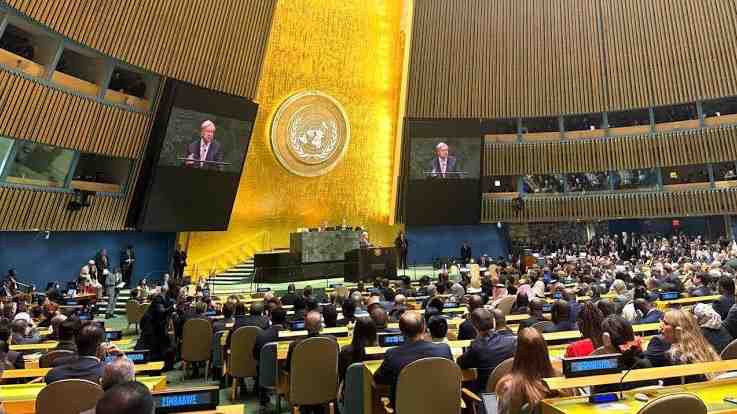








AMERICA - Ten years after the Paris Agreement, the climate conversation in New York sounded different.
At the High-level Event on Climate Action and the Just Transition, held on 23 September during the 81st session of the UN General Assembly, leaders gathered at a moment the United Nations described in stark terms: the energy transition is accelerating, but a temporary overshoot of the 1.5°C warming threshold is now considered inevitable. The question is therefore no longer only how to cut emissions, but how to transform energy systems quickly, fairly and while protecting people from impacts already unfolding.
That is essentially what a climate transition means: moving economies away from carbon-intensive energy and development systems toward cleaner, low-emission and climate-resilient ones. But adding the word “just” makes the challenge much broader. A transition cannot be considered successful simply because more solar panels, wind farms, or electric vehicles are deployed. It also has to consider who can afford the transition, what happens to workers and communities, whether energy remains reliable, and whether developing countries have access to the finance and technology needed to participate.
From Commitments to Implementation
Three issues dominated the UN session: accelerating the transition to renewable energy, scaling up affordable climate finance for developing countries, and strengthening adaptation and resilience as climate impacts intensify.
UN Secretary-General António Guterres captured the urgency bluntly: “We are the first generation with the tools to end the fossil fuel age – and the last who can avert climate catastrophe.” He called for countries to develop credible roadmaps with timelines for moving away from fossil fuels, while expanding renewables, electrification, and adaptation.
But some of the clearest messages came from countries already living with the consequences of climate change. Speaking for the Alliance of Small Island States and the Pacific Islands Forum, Palau’s President Surangel Whipps Jr. called for climate action to move “from commitments to implementation,” stressing that finance, technology and capacity support remain essential if vulnerable countries are expected to deliver their climate plans.
The meeting also showed what “implementation” increasingly looks like. Around the summit, the UN launched a Global Grids Accelerator to help developing regions build the electricity infrastructure needed to carry growing renewable power, alongside a mechanism intended to help mineral-producing developing countries gain greater economic benefits from the materials underpinning the clean-energy transition. Progress on expanding early-warning systems was also highlighted.
The message was significant: the next phase of climate action is not only about targets. It is about infrastructure, investment, institutions, and protection.
Does This Picture Look Familiar in Lebanon?
In some ways, Lebanon is already experiencing its own version of the energy transition — but largely by necessity rather than design.
Years of electricity shortages pushed households and businesses toward private solar systems. By the end of 2024, standalone solar PV with battery storage had reached around 1,400 MW of capacity. Yet the World Bank notes an important limitation: this expansion largely benefited those able to afford the upfront investment.
That is precisely where the idea of a just transition becomes relevant.
Solar panels on rooftops can reduce dependence on diesel and provide households with greater energy security, but they do not by themselves create a fair or functioning national energy transition. Lebanon still needs reliable grids, storage, regulation, affordable financing, and solutions accessible to households that cannot purchase their own systems.
The country has already set climate goals. Under its NDC 3.0, Lebanon aims to cut greenhouse gas emissions by 22% unconditionally and 33% with additional support by 2035, while renewable energy would meet 25% of electricity demand unconditionally and 30% conditionally. The difference between those targets also tells an important story: greater ambition depends partly on access to international finance.
And the transition cannot stop with electricity. Lebanon is also highly exposed to climate pressures affecting water, agriculture and forests, meaning adaptation must advance alongside emissions reduction.
The country does not need to join a global race to install more renewable energy. It needs to turn an already unfolding, fragmented transition into one that is planned, affordable, and resilient.
The debate at UNGA 81 suggests that the next chapter of climate action will be judged less by the promises countries make and increasingly by whether those promises translate into systems that work, and work for everyone.