






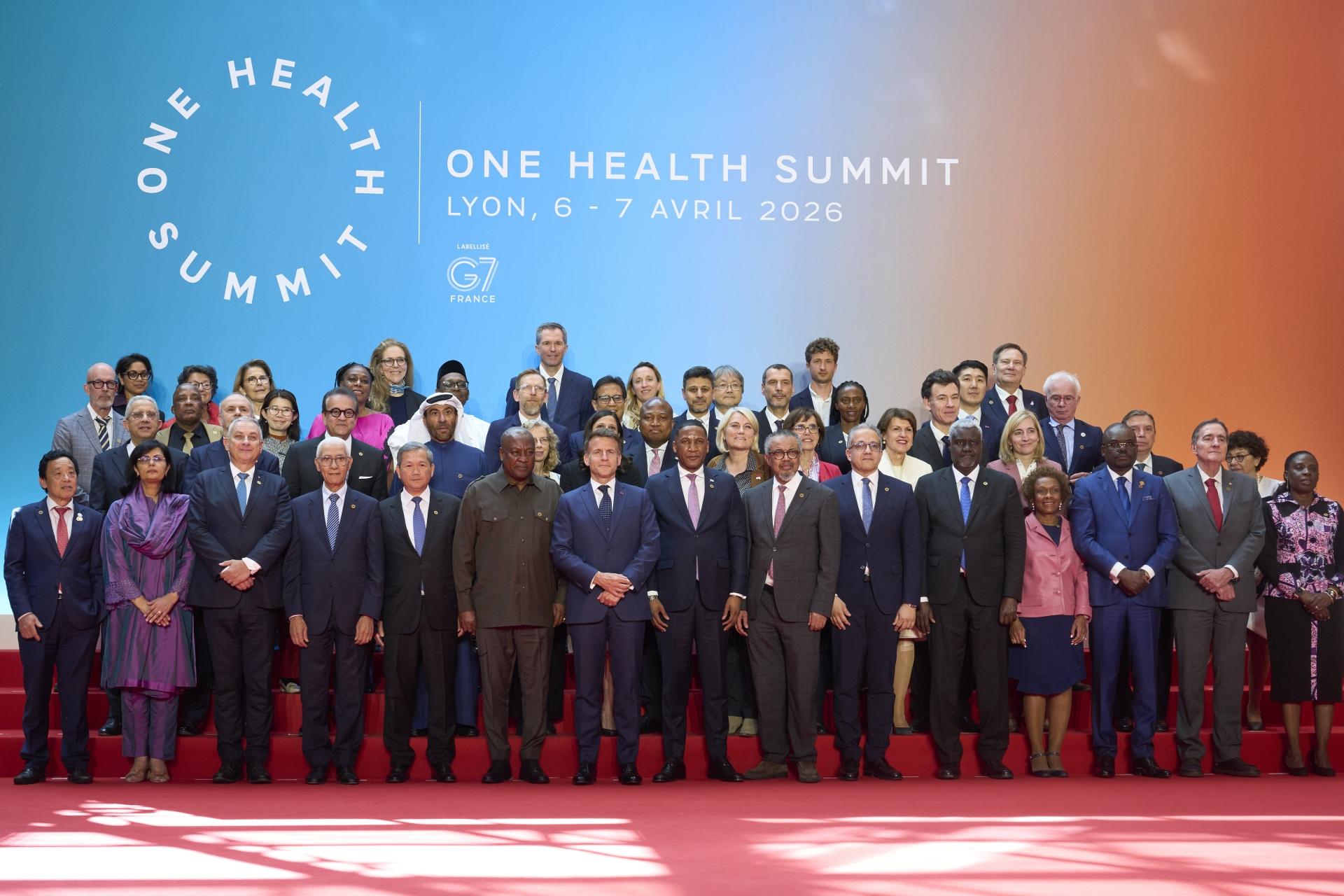
WORLD - On World Health Day, global leaders gathered in France for a landmark “One Health Summit,” where the World Health Organization (WHO) and its partners announced a new set of actions to better protect people, animals, and the environment from future health crises.
The evidence is clear: around 60% of known infectious diseases in humans come from animals, and nearly 75% of new or emerging diseases are zoonotic, meaning they spread between animals and people.
At the same time, growing challenges like climate change, environmental damage, food and water insecurity, biodiversity loss, and unequal access to healthcare are making these risks more serious.
The COVID-19 pandemic showed what is at stake, with an estimated 15 million deaths and trillions of dollars in economic losses, highlighting the consequences of failing to properly manage the links between human, animal, and environmental health.
The Summit brought together heads of state, government officials, scientists, and policymakers, highlighting the importance of global cooperation in tackling shared health challenges.
Its outcomes are expected to help shape ongoing international discussions, including at the G7 level, on improving preparedness and coordinated responses to health threats that affect people, animals, and ecosystems.
WHO announced four major One Health actions:
1- A new global network of institutions on One Health
WHO and its partners, the Food and Agriculture Organization, the United Nations Environment Programme, and the World Organisation for Animal Health, plan to launch a Global Network of One Health Institutions.
This network will bring together experts from different fields to provide more coordinated support to countries. It will offer practical tools, guidance, and training to help governments put the One Health approach into practice more effectively.
2- Stronger science to guide global action
WHO and its partners also announced the extension of the One Health High-Level Expert Panel (OHHLEP), a key international scientific advisory group. Its mandate has been renewed through 2027, with plans to continue beyond that.
The panel will help shape global research priorities, support the implementation of the One Health plan, and promote evidence-based decision-making.
3- A new push to eliminate rabies by 2030
WHO, the World Organisation for Animal Health, and the Institut Pasteur launched a renewed effort to eliminate rabies transmitted by dogs by 2030.
Although rabies can be prevented with vaccines, it still causes around 60,000 deaths each year, mostly affecting children in high-risk regions. The initiative will focus on stronger political commitment, better local monitoring, and research, using rabies elimination as a model for broader disease prevention efforts.
4- A unified strategy to tackle avian influenza
WHO and its partners introduced a new framework to better coordinate global responses to avian influenza.
The strategy aims to bring together surveillance, risk assessment, and response efforts across sectors, while also addressing the wider impact of outbreaks on public health, food systems, livelihoods, and biodiversity.
WHO to Lead Global One Health Coordination
WHO has taken on a leading role within the partnership that includes FAO, WOAH, and UNEP, signaling a stronger push for coordinated global action. The focus will be on delivering measurable results at the country level, improving coordination, and strengthening research and advocacy efforts.
Alongside the Summit, WHO also hosted its first Global Forum of Collaborating Centres from 7 to 9 April, bringing together more than 800 institutions from over 80 countries. The Forum included senior representatives from countries such as France, Germany, Indonesia, South Africa, and Japan, and aims to support scientific collaboration, data sharing, and capacity-building worldwide.
Together, the Summit and the Forum highlight a shared message: addressing today’s complex health challenges requires strong international cooperation, sustained investment in science, and a clear commitment to putting the One Health approach into action at both global and national levels.