







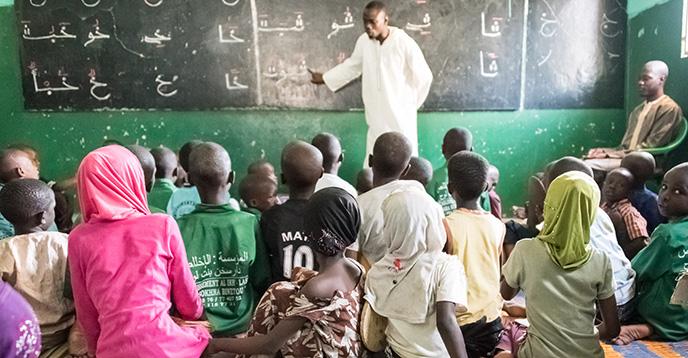
ARAB WORLD - Over the past three decades, higher education has expanded dramatically across the Middle East and North Africa. Net enrolment rose from 86% to 94% between 2000 and 2016, and the average level of schooling has quadrupled since 1960.
While education in recent years has become a top priority in the reform agenda for many policymakers in MENA countries, the region also holds a less flattering record. Arab countries recorded the highest youth unemployment rate in the world in 2023, at 28.6%, according to the International Labour Organization (ILO).
This is the MENA paradox: an education boom that has not translated into jobs, alongside a data gap which makes the problem hard to even measure.
Education as an Economic Investment
Economists have long treated education as a form of capital: money and time invested today that raises a worker's future productivity. The World Bank's Human Capital Index captures this directly, estimating that a child born in MENA today can expect to reach only 57% of the productivity they would have with full health and complete education, a regional average that hides enormous variation, from 67% in the UAE down to 37% in Yemen.
In theory, expanding access to education should lead to a more productive workforce, higher wages, and faster economic growth. In much of the MENA region, however, this expected relationship has been weakened by persistent structural challenges.
The MENA Education Paradox
The regional unemployment numbers tell an uncomfortable story. ILO data show Arab States' youth unemployment easing only slightly, to a projected 27.7% by 2025, with young women facing nearly one-and-a-half times the joblessness rate of young men (38.5% versus 25.7% in 2023). North Africa performs a little better, at 22.3% youth unemployment in 2023, with a 34% rate for young women against 18.8% for young men.
Nearly a third of the region's youth are not in employment, education, or training (NEET), one of the highest shares of any world region and one that keeps MENA off track on the UN's SDG target to cut youth unemployment.
What makes this a genuine paradox rather than simple underinvestment is that more education can actually correlate with worse job prospects. Research compiled by the ILO and regional labour-market analysts has found that tertiary-educated Arabs are roughly three times more likely to be unemployed than those without a university degree. This reflects a clear skills mismatch between what universities teach and what employers, particularly the private sector, actually need.
Public-sector hiring, long the default absorber of graduates, has become unsustainable across much of the region, while women, who now outnumber men among university graduates in much of the Arab world, remain roughly three times more likely than men to be unemployed.
Informality compounds the problem: two-thirds of total employment in the Arab region is informal, offering neither job security nor the payroll and tax records that feed into national labour statistics.
The Invisible Countries and Learning Poverty
Behind this regional picture sits a second, quieter crisis: entire education systems that barely register in the data. Yemen, Sudan, Mauritania, Djibouti, Somalia, and Syria, the World Bank's low-income and fragile Arab states, are frequently missing from cross-country education rankings, not because schooling doesn't happen, but because conflict, displaced administrative staff, and weak civil registration make it nearly impossible to count who is enrolled, learning, or employed.
UNESCO reports that only around 43% of its developing-country partners report on the majority of core education indicators, and fewer still report on learning quality. Regional learning poverty (the share of 10-year-olds unable to read a simple text) was estimated at 60% before the pandemic and rose to 71% afterward, meaning university access is a distant prospect for most children in these countries long before unemployment statistics even become relevant.
Why the Data Gap is Not Just an Economic Problem
Missing data slows down development. International aid and investment increasingly flow toward measurable outcomes, enrolment gains, learning assessments, labour-market indicators, and countries unable to produce that evidence become less competitive for financing.
Human capital, in turn, is a recognized driver of growth and productivity, so weak education statistics feed directly into weak policy design, which feeds back into poor education and labour outcomes.
Escaping the Trap
This creates a dynamic that economists recognize as a trap. The countries that most need investment in their education systems are often the least able to demonstrate the conditions that attract it. Without data, reform is difficult to design. Without reform, outcomes do not improve. Without improved outcomes, the case for investment weakens further.
MENA's challenge is no longer simply getting more students into classrooms, enrollment has already tripled. It is building labor markets and information systems capable of turning that education into productivity, jobs, and growth, and doing so in a way that includes the region's most fragile states rather than leaving them behind.