






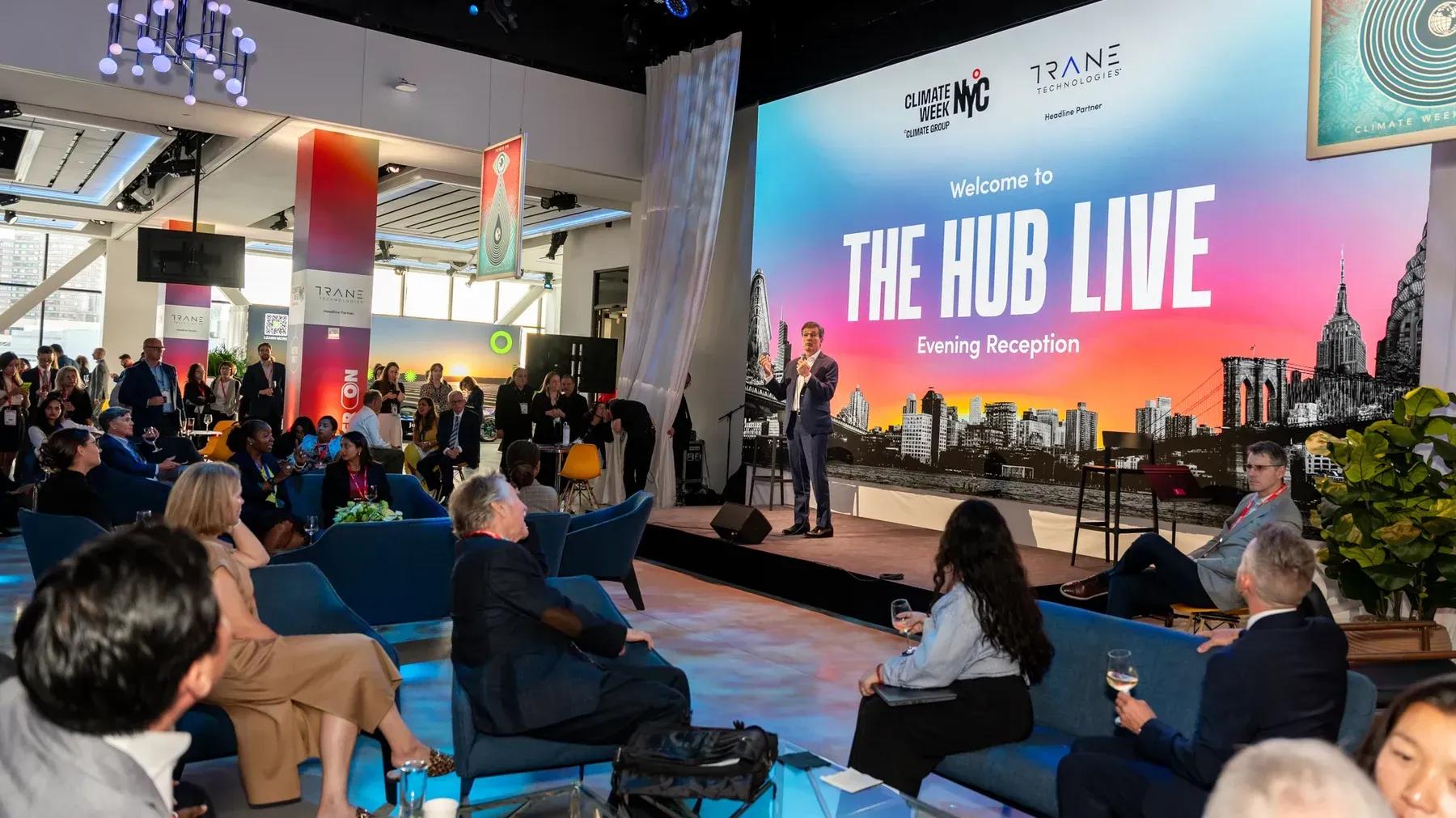
LEBANON — As world leaders gather in New York for the United Nations General Assembly, another major global conversation is unfolding across the city. Climate Week NYC 2026, which runs from 20 to 27 September, brings together governments, businesses, investors, researchers and civil society around more than 1,000 events, attracting over 100,000 participants each year.
The official programme opened on 21 September under this year’s strapline: “Energy. Impact. Action.” But behind those three words is a broader shift in the global climate conversation.
From Ambition to Implementation
According to Climate Group, which organizes the week, the challenge today is “not ambition, but implementation.” Energy systems are changing, electricity demand is growing with electrification, artificial intelligence and digital infrastructure, while supply chains, infrastructure and economies face growing pressures.
This context is reflected directly in this year’s programme. The opening session, “Higher Stakes, Harder Choices,” examines how climate, energy and economic realities are becoming increasingly interconnected.
Another flagship discussion, “Navigating a World in Flux,” brings together questions of energy costs, disrupted supply chains, extreme heat, flooding and geopolitical pressures.
Other events throughout the week address climate finance, food systems, resilient infrastructure, transport, health, nature, artificial intelligence and clean technology.
Why the Global Debate Matters for Lebanon
These may be global discussions, but many of the questions raised in New York are immediately recognizable in Lebanon.
How can countries secure reliable and affordable energy while reducing emissions? How can infrastructure become more resilient? Where will financing for adaptation come from? How should cities respond to increasing climate risks? And how can climate priorities survive when governments are simultaneously dealing with economic, social and geopolitical pressures?
The connection is particularly timely because Lebanon is also represented in New York during UNGA 81. President Joseph Aoun is heading Lebanon’s delegation to the General Assembly, while Prime Minister Nawaf Salam has also travelled to New York for UN meetings and bilateral discussions.
Lebanon’s Climate Roadmap
Lebanon is also not entering this conversation without a climate roadmap. Its climate policy framework brings together the National Adaptation Plan for 2025–2035, the updated Nationally Determined Contribution (NDC 3.0), and the Long-Term Low Emission Development Strategy.
The National Adaptation Plan identifies eight climate-sensitive sectors: agriculture, forestry, water resources, biodiversity, urban infrastructure, public health, disaster-risk reduction and tourism.
Meanwhile, Lebanon’s NDC 3.0 sets mitigation and adaptation targets to 2035, while highlighting persistent gaps in financing, data and institutional coordination that could limit implementation.
The Implementation Challenge
This is where the message coming from New York becomes particularly relevant.
For Lebanon, and for other countries across a region facing climate pressures alongside economic and geopolitical instability, the climate question is no longer limited to reducing emissions.
It is increasingly connected to how countries produce energy, protect water and food systems, finance infrastructure, manage cities, attract investment and strengthen their ability to withstand future shocks.
Climate Week NYC may be taking place thousands of kilometres from Beirut, but many of the questions being asked there are already Lebanese questions.
The challenge now is not simply to have climate plans on paper, but to determine how they can become part of the country’s investment, recovery and development decisions.