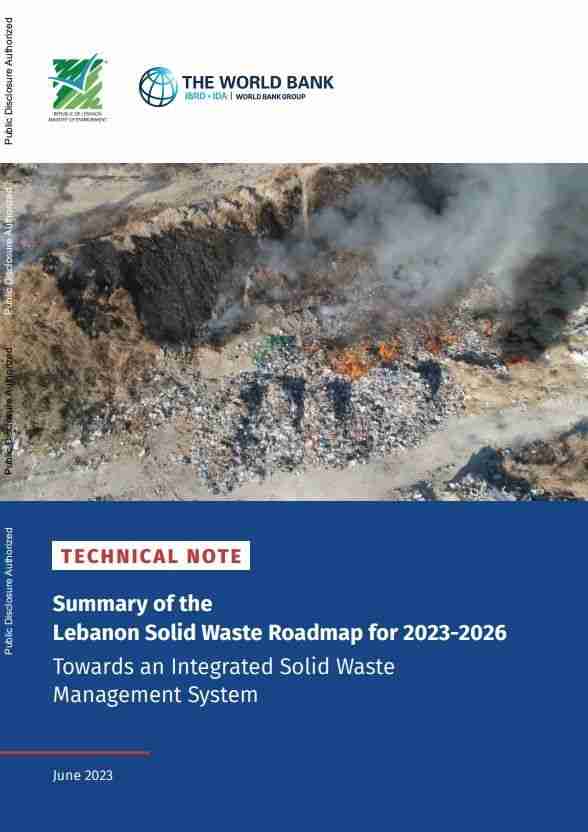






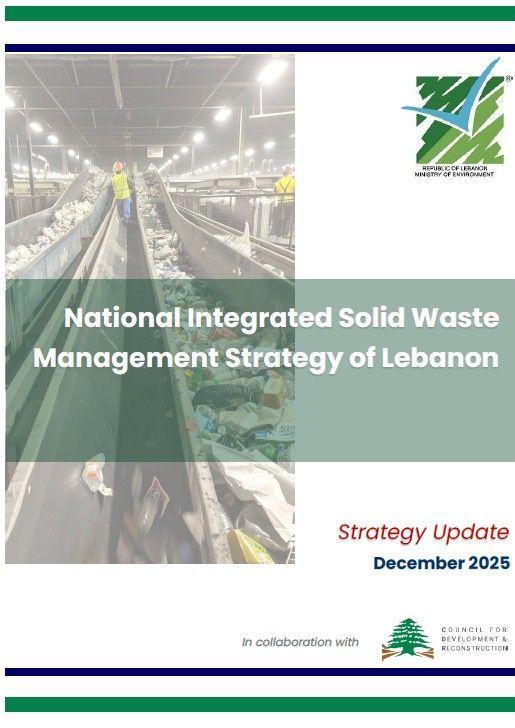

The National Integrated Solid Waste Management Strategy – Update 2025 was issued by Lebanon’s Ministry of Environment as an updated national framework for reforming the solid waste sector. It builds on Lebanon’s 2023–2026 Solid Waste Roadmap and the updated National Integrated Solid Waste Management Strategy, which were prepared with support from the World Bank, CDR, UNDP and technical partners. The strategy aims to move Lebanon away from crisis-based waste management toward an integrated system based on governance reform, waste diversion, infrastructure investment, cost recovery, circular economy principles, and better environmental protection.
Key insights:
Lebanon’s solid waste sector has long suffered from weak governance, poor coordination, financial unsustainability, and lack of strategic planning, leading to repeated waste crises and unsafe disposal practices.
The strategy is structured around three main priorities: improving sector governance, increasing waste diversion, and investing in essential collection, treatment, and disposal infrastructure.
A central reform is the establishment and operationalization of a National Solid Waste Management Authority, which would support planning, coordination, regulation, and implementation of the waste management system.
The strategy also calls for a National Solid Waste Management Information System to provide reliable data on waste generation, collection, recycling, treatment, landfilling, and disposal.
Waste diversion is a major pillar, with emphasis on sorting at source, recycling, drop-off centers, public awareness, and reducing the amount of waste sent to landfills.
The strategy promotes a circular economy approach, including community participation, private sector engagement, integration of the informal sector, and standards for recyclable products.
Infrastructure remains a key need, including upgraded collection and transportation systems, material recovery facilities, climate-smart waste treatment, final disposal facilities, and the closure or rehabilitation of open dumps.
Financial sustainability is a core challenge. The roadmap notes that before the financial crisis, the waste sector cost the central government around USD 180 million per year, while the environmental degradation cost from waste was estimated at around USD 200 million in 2018.
The strategy stresses the need for cost recovery, better financial accounting, and extended producer responsibility so that the sector is not fully dependent on unstable public funding.