







MIDDLE EAST - Room to Read’s work in the Middle East has grown into a significant and expanding presence across the region, where education systems are often shaped by conflict, displacement, and instability. The organization’s regional programming has been developed and scaled under its current leadership and teams on the ground, in close collaboration with local partners.
Founded in 2000 by John Wood following an encounter with a school headmaster in Nepal who needed help filling a library under its current leadership, Room to Read has evolved into a global education nonprofit focused on foundational literacy and girls’ education, with implementation today driven by its regional and country teams.
“In the Middle East, Room to Read’s mission to nurture foundational literacy and life skills is translated through a contextualized approach that supports children in a dignified and gender-equal way, particularly in environments affected by conflict, displacement, and instability,” Dina Elabd, Project Manager for the organization in the region, tells Enmaeya.
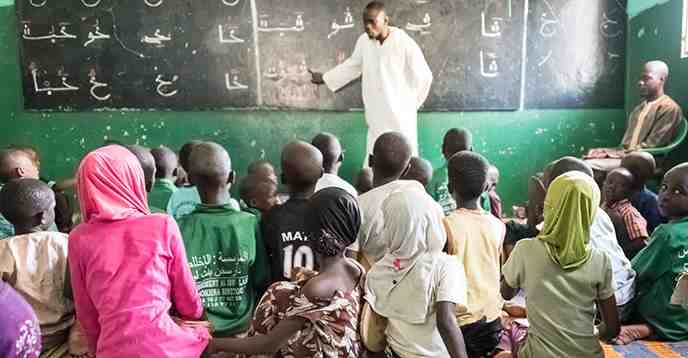
The organization works across Lebanon, Jordan, and Palestine through partnerships with governments, schools, and local organizations to help keep learning systems functioning even when formal structures are disrupted.
“We work directly with children and educators, while also partnering with governments, schools, and local organizations to strengthen education systems and ensure continuity of learning in both formal and non-formal settings,” Elabd explains.
Since launching in the region in 2017, the organization has reached nearly 300,000 children, supported 58 schools, and distributed more than 1.1 million Arabic-language books.
A Regional Response
As instability across parts of the Middle East continues to reshape access to education, Room to Read’s strategy has shifted.
“In the Middle East specifically, we continue to deepen our impact through our regional strategy, focusing on scalable literacy and life skills programming, strengthened partnerships, and system-level integration to ensure more children can access foundational learning in crisis-affected contexts,” Elabd says.
That strategy is anchored by the Middle East Fund, a multi-year initiative designed to expand programming in both current and new countries across the region.
“Room to Read’s Middle East Fund is a dedicated regional initiative designed to expand access to foundational literacy and life skills for children affected by conflict, displacement, and systemic educational inequities across the Middle East.”
The Fund, valued at approximately US$5 million over 2025–2027, is focused on strengthening Arabic-language literacy curricula, scaling teacher training, and expanding safe learning spaces. It also supports exploratory engagement in countries including Egypt, Iraq, Syria, and the United Arab Emirates.
Lebanon: Education in Crisis
Nowhere is the need for flexibility clearer than in Lebanon, where a long economic crisis and ongoing instability have put heavy pressure on schools and families.
“The ongoing instability in Lebanon has reinforced the need for highly flexible, responsive programming from Room to Read,” Elabd explains. “Our approach prioritizes continuity of learning, recognizing that children are often learning in unpredictable and rapidly changing environments.”
In practice, that means designing education that can move with children, across schools, shelters, and community spaces without losing structure or quality.
“Today, our work in Lebanon spans three core components: library read-aloud and storytelling activities, literacy-enriching programming, and life skills support - including psychosocial care for children who have experienced trauma during the war.”
One adaptation has been the creation of flexible reading and library models that operate in both formal and emergency settings.
“In response to displacement and school closures, Room to Read has worked with its local partner, The Lebanese Organization for Studies and Training (LOST), in direct coordination with the Ministry of Education and Higher Education, to deliver structured reading sessions in emergency settings.”
These sessions combine storytelling, guided discussion, and creative expression, including drawing, to support both literacy and emotional well-being. Even curriculum materials have been redesigned for crisis conditions.
“Room to Read has also adapted its Modern Standard Arabic Grade 1 literacy curriculum for 6- and 7-year-olds living in shelters to help ensure continuity of learning and prevent educational gaps from developing during periods of crisis.”
For older children, programming has also shifted to reflect lived realities. “We piloted our life skills after-school curriculum for children ages 10–14, with a particular focus on conflict resolution - a topic directly connected to many children's lived experiences in Lebanon today.”
Measuring Success
For Room to Read, success is defined not just by enrollment or access, but by measurable learning outcomes and long-term confidence in children’s abilities.
“Impact means children are developing foundational literacy and life skills that enable them to continue learning, build confidence, and create opportunities for themselves and their communities,” Elabd says.
In several contexts, students in Room to Read-supported programs show “up to 2x improvements in reading fluency and comprehension compared to peers in comparison schools.” In the Middle East, ongoing studies are being conducted to evaluate literacy and life skills interventions, including library-based programming in Lebanon.
Operating in Fragile Environments
Delivering education in fragile environments brings constant operational constraints. Displacement, school closures, and infrastructure challenges require continuous adaptation.
“Key challenges include maintaining continuity of learning during instability, ensuring access to quality learning materials, and supporting educators working under significant constraints,” Elabd notes.
In Lebanon, even logistics can become a barrier, with rising operational costs and restricted movement affecting implementation. Yet local partnerships often become the backbone of resilience.
This was visible when a large-scale book distribution led to “over 300 reading corners spontaneously being created across Lebanon in the highest need areas,” supported by remote training and digital tools.
Community ownership is also embedded physically in learning spaces, where local artists contribute murals to libraries—transforming them into shared cultural and educational spaces.
Looking Forward
Over the next three to five years, Room to Read aims to significantly expand its regional reach while embedding its approach more deeply within national education systems.
“Success means significantly expanding access to foundational literacy and life skills for children across the region, while embedding Room to Read’s approaches within national education systems to ensure sustainability at scale.”
By 2027, the organization aims to reach at least 100,000 children annually across the Middle East and expand programming into at least four countries.
“Future funding and partnerships are critical to scaling localized content, strengthening educator training and support systems, expanding library and non-formal learning models, and ensuring more children across the region can continue learning with dignity despite ongoing challenges.”